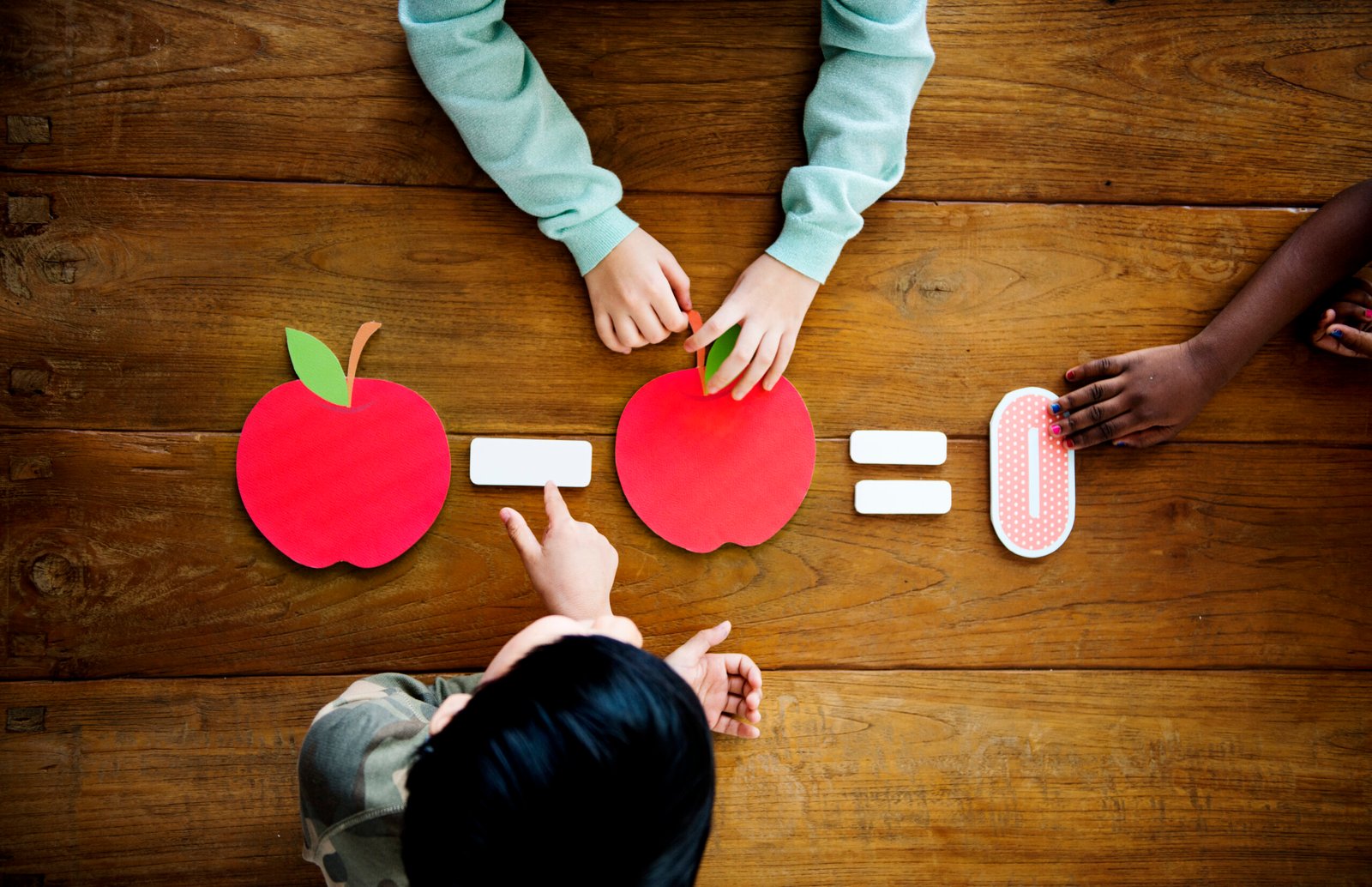
There is a particular kind of quiet that happens at a kitchen table when a child decides they are bad at math.
You know the one. The pencil stops. The shoulders come up. The eyes go somewhere far away, because staying in the room means staying in the feeling, and the feeling is I am the kind of person who can’t do this.
I have watched that quiet settle over a child I love. So I went looking for a math curriculum for struggling learners — something built for a kid who needs math to go slower, or differently, than the worksheets allow. I couldn’t find one I trusted. So I built it. It’s called Peculiar Math, and this is what it is and why it exists.
First, what Peculiar Math actually is
I’m Gina. I homeschool my six kids, and between us we have a whole collection of brains that don’t run on the standard schedule — mine included. (If you want the longer version of that story, it’s on my about page.)
Peculiar Math is a full-year math curriculum for the early years, roughly kindergarten through second grade. Level 1 is finished: thirty-eight weeks of lessons. I built it specifically for the kids most programs leave behind — kids with dyscalculia, kids with ADHD, autistic kids, and honestly any kid who looks at a page of numbers and shuts down.
It is not faster math. It is not flashier math. It is math built slowly and solidly, from the ground up, so a child actually understands what a number is before anyone asks them to do anything with it.
That’s the whole thing in a sentence. Now let me tell you why it has to work this way.
Why most math programs fail struggling learners
Most early math programs are built on a quiet assumption: that a number is an obvious thing.
That a child can look at the numeral 7, hear the word “seven,” picture seven of something, and understand that all three are the same idea wearing different clothes. That this happens fast, on the first or second try. That if you keep the worksheets moving, understanding will keep up.
For a lot of kids, it does.
For kids with dyscalculia — a real, biology-based learning difference, not just “being bad at math” — it does not. And dyscalculia isn’t rare: research suggests somewhere between 3 and 6 percent of people have it, which means most homeschool co-ops have a few. Add the kids with ADHD, the autistic kids, and the kids who simply run on a different internal clock, and you have a whole lot of children the standard worksheet pace was never built for.
The worksheets keep moving. The understanding doesn’t. And somewhere in that gap a five-year-old quietly decides they’re bad at math — years before anyone has actually taught them what a number means.
That gap isn’t the child failing. It’s the curriculum failing the child.
What a math curriculum for struggling learners has to do differently
I’m not trying to make math fast. I’m trying to make it solid. So the whole thing is built like a house — foundation first, nothing skipped because it seemed obvious.
Kids learn to see numbers before they write them. Before a child ever picks up a pencil, they practice looking at a small group of things and knowing how many without counting one by one. There’s a name for that skill — subitizing — and most programs skip right past it. It’s the foundation everything else sits on.
Hands before paper. Every new idea starts with real objects a child can hold, then moves to pictures, then to written numbers, in that order, every time, because that’s the order kids’ brains actually learn in.
We stay in the small numbers and don’t rush. Level 1 lives almost entirely in zero to ten. Ten numbers a child truly knows are worth more than a hundred they’ve half-memorized. A kid who deeply understands what six is — what it looks like, what it’s made of, how it breaks apart and comes back together — has something no flashcard can give them.
And it all happens inside a story. The math doesn’t float in a void of bare numerals. It lives in Sol’s house: a warm, multigenerational family where Grandma’s in the garden, Mom’s in her workshop, Dad’s selling at the market, and numbers show up the way they actually do in a real life — in seeds and tomatoes and coins and dividing a snack between people who love each other. I made this family specific and ordinary on purpose, so a kid who’s never seen their own kitchen in a textbook can open this one and feel at home.
That combination — see before write, hands before paper, slow and small, wrapped in story — is what an early math curriculum for struggling learners actually needs. Not more drilling. A better foundation.
Built for your capacity, too
Here’s the part that matters most to me.
Peculiar Math is built for the child who struggles. But it’s also built for you — the parent teaching it, possibly on a day when your body and your brain have stopped speaking to each other.
There are no aesthetic flat-lays to recreate. No elaborate morning routine. No assumption that you have unlimited energy or a nervous system that shows up on schedule. The lessons are scripted enough that you can teach them on a foggy day without inventing anything, and gentle enough that a hard week doesn’t blow up the whole plan. If you’ve ever tried to homeschool through a flare, a med change, or a stretch where survival was the lesson plan, this was made with you in the room. (That principle runs through everything in the homeschooling side of this site, not just the math.)
Capacity first. Your child’s, and yours.
When it’s coming, and how to get the free sample
Peculiar Math Level 1 is finished, and I’m getting it ready to share this summer.
I’m going to give away the first two weeks free, so you can sit at your own kitchen table and see how it feels before you spend a dime. If you have a kid who’s already gone quiet at the math table — or one who hasn’t started yet, and you’d like to keep it that way — I’d love to put it in your hands.
The best way to get the free sample the day it drops is to stick around here.
The math curriculum I couldn’t find is almost ready. I’m so glad I stopped waiting for someone else to build it.
— Gina